The lifecycle

From a requirement to a release you can defend.
AceLM combines planning, execution, review, and continuous learning to improve quality, speed, and cost while giving people control over how much responsibility they delegate. The lifecycle is how that happens, one gate at a time.
It is the same loop as on the overview, plan, build, review, verify, and learn, with each step opened up to show exactly what it must prove.
An agent saying "done" is a claim, not a result. Each gate asks for the evidence before the work moves on, so "done" means the same thing every time.
Six stages

Every stage leaves evidence for the next.
Take a small fix: expired sessions must be rejected (requirement AUTH-03). The regression tests pass, but a dependency review finds an unresolved vulnerability, so the release stays blocked. Here is how each stage keeps those results connected and in view.

Specify
Gate: requirements written down
Record requirements, scope, constraints, architecture, interfaces, design assumptions, and acceptance criteria.

Plan
Gate: every task has a check
Document the approach, alternatives, tradeoffs, affected files, and dependencies. Pair execution work with explicit verification obligations.

Review and accept
Gate: a person accepts the scope
Independently challenge the requirements, architecture, design, and plan. Resolve blocking findings and record scoped acceptance separately from the review verdict.

Build
Gate: work stays in scope
Execute accepted work in separate Git worktrees. Record changes, decisions, deviations, and proof of work; newly discovered scope needs the appropriate review and authority.

Verify
Gate: evidence for the final revision
Independently check completeness against accepted requirements and observed functionality. Run applicable tests, regression checks, builds, linting, type checks, and security checks. Record evidence for the final revision and identify skipped or unavailable checks.

Check release readiness
Gate: a person authorizes the release
Evaluate required evidence, documentation, and unresolved findings. Surface blockers for the team's release decision.
A passing check has a scope
Verification records are intended to show what ran, what it evaluated, and what remains unresolved. Passing checks provide evidence for the tested scope; they do not establish that every requirement is met or every vulnerability is absent.
State machines

How work gets iterated and why it gets better.
Every piece of work, from a specification to a release, moves through written states. When a problem turns up, the work goes back to the step that can fix it, and the reason is recorded, so the next attempt starts from what the last one learned. Nothing skips a gate quietly.
Red lines are kick-backs: where a problem is found, and the step the work returns to. Each numbered card says what triggers it. marks where a person decides.
Specification

Backlog item

Plan

Release

Shared rules

All four on one page: open the full-size lifecycle-flowchart.svg
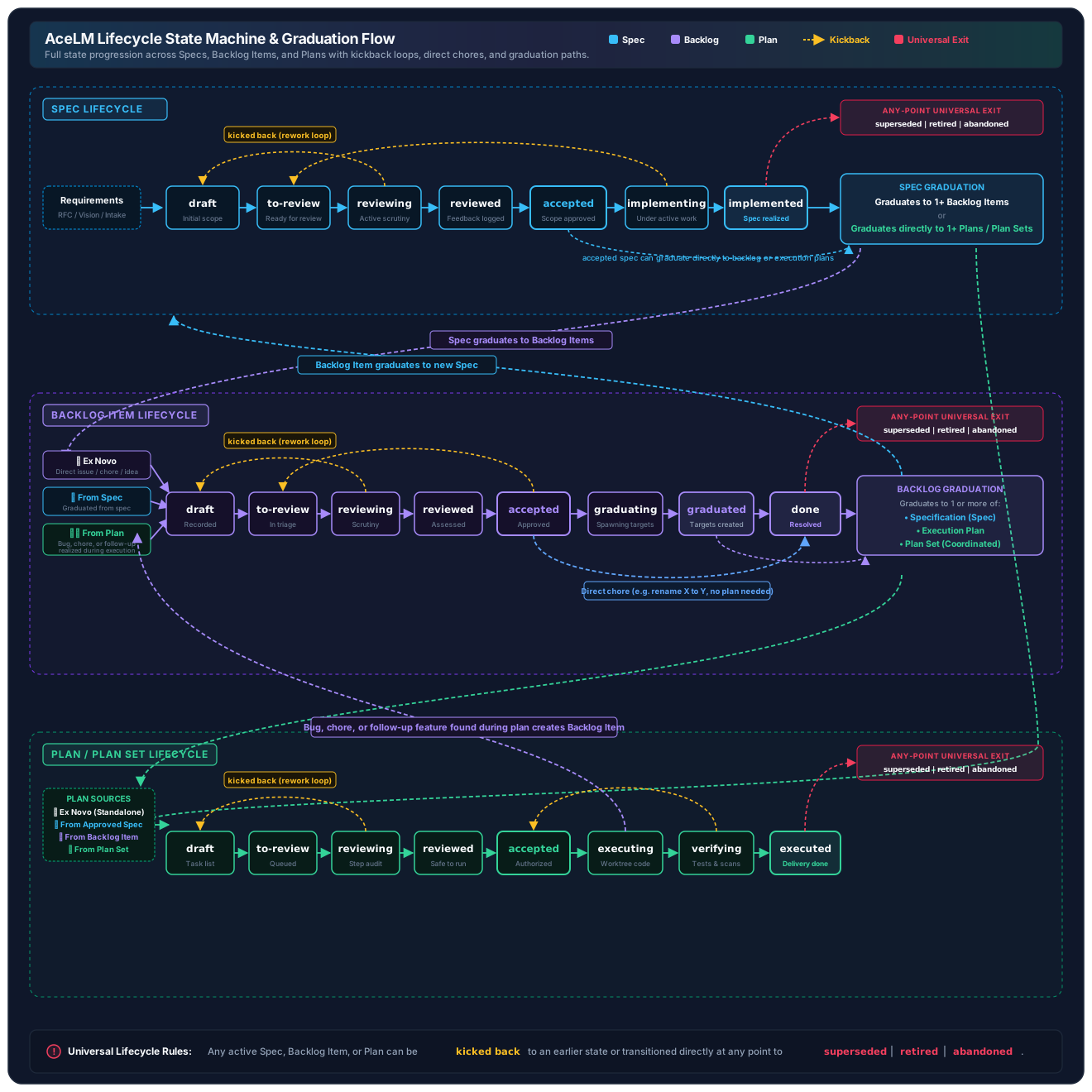
Show every state, kick-back, and failure rule
The diagram is the overview. The detailed rules for execution, verification, derivation, and recovery, and the status vocabulary, are in the documentation for invited teams. Work keeps the phase it reached while it waits, so nothing silently slides backward.
Specification
SpecBacklog Item
BacklogPlan
PlanRelease Candidate
ReleaseUniversal Lifecycle Rules & Failure Dispositions
Changed artifact content or scope requires draft, fresh independent review, and renewed acceptance; unchanged-content reassessment uses to-review. Ordinary dependency waits retain phase with Run wait and readiness no-go; pending approval alone uses issue and need-ok when other gates pass. Artifacts can also be transitioned to universal dispositions: superseded (replaced by a newer artifact), retired (deprecated or obsolete), or abandoned (cancelled with audit rationale).
When retries or infrastructure boundaries are hit, AceLM records precise failure classifications: rejected (exhausted review retries), verify-err (exhausted verification retries), exec-err (operation failure), gate-fail (unrecoverable gate or exhausted authorized gate-remediation budget), interrupt (SIGINT/interruption), or crashed (unclean worker death). Every label fits a ten-character column, so the terminal shows it in full.
Early access
Your standards decide what each gate requires.
Bring the checks your team already trusts. We will show you how they become gates on a real project of yours.